Global Solidarity Local Actions Toolkit
Social Media Series Spring 2026
-
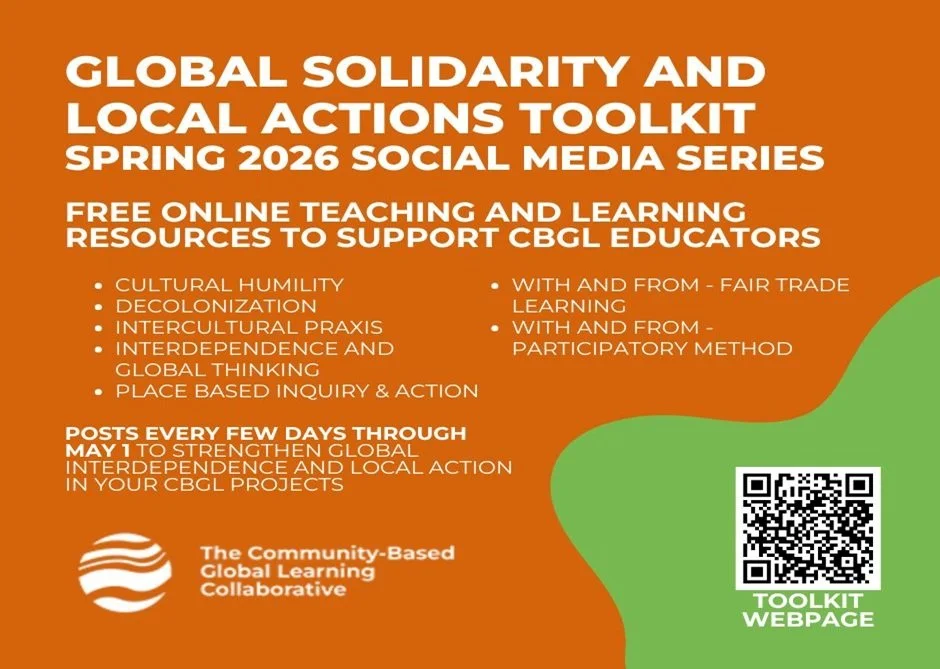
Kick-off
We are excited to announce the launch of our spring 2026 Global Solidarity and Local Actions Toolkit social media series!
Our Toolkit is a free online teaching and learning resource. It was created and is stewarded by Collaborative members to support CBGL educators in shaping participant experiences. In this season of hope and renewal we are lifting up and encouraging you to explore some of lesson plans or modules, organized around 7 topical areas. Look for posts every few days with Toolkit resources to build/strengthen global interdependence and local action in your CBGL projects. Invite others into the conversation by reposting with #GlobalSolidarityLocalActionsToolkit -
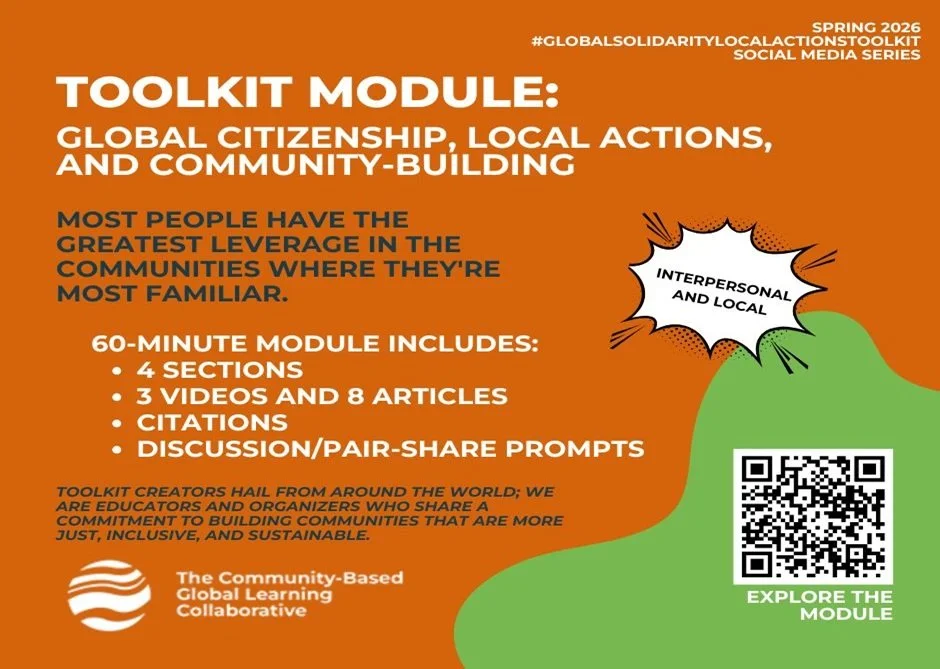
Global Citizenship, Local Actions, and Community-building
What does global citizenship have to do with local actions and community-building? The Collaborative is interested in global justice, and the resources in this module help us all think about the relationships among how we identify, interdependence, and local actions. The mere act of crossing a border does not dispose a person to collaborative, ethical, and informed capacities to co-create more just, inclusive, sustainable communities. The challenge of cosmopolitanism draws us back to a compelling question in an unmistakably interdependent world: what obligations do we have to one another? This post is the second in our #GlobalSolidarityLocalActionsToolkit spring 2026 social media series.
-
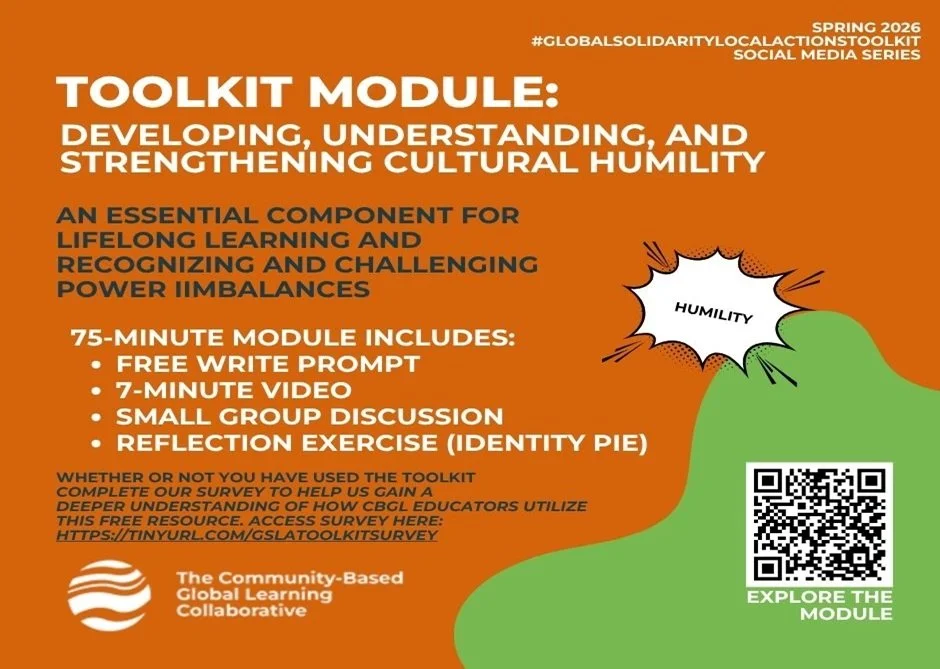
Developing, Understanding, and Strengthening Cultural Humility
Moving through the world with cultural humility is an ongoing, lifelong learning process for people of all social identities. This interactive lesson plan supports your CBGL participants to articulate core concepts of cultural humility and identify their deeply held cultural assumptions.
The centerpiece is a 7-minute video by San Francisco State University Associate Professor of Health Education Vivian Chávez, physician and consultant Melanie Marie Tervalon, and UC Davis nursing professor Jann Murray-García, MD, MPH. This module in our #GlobalSolidarityLocalActionsToolkit – together with direct experience and critical reflection – can be an essential component for recognizing and challenging power imbalances for successful partnerships and institutional accountability. -
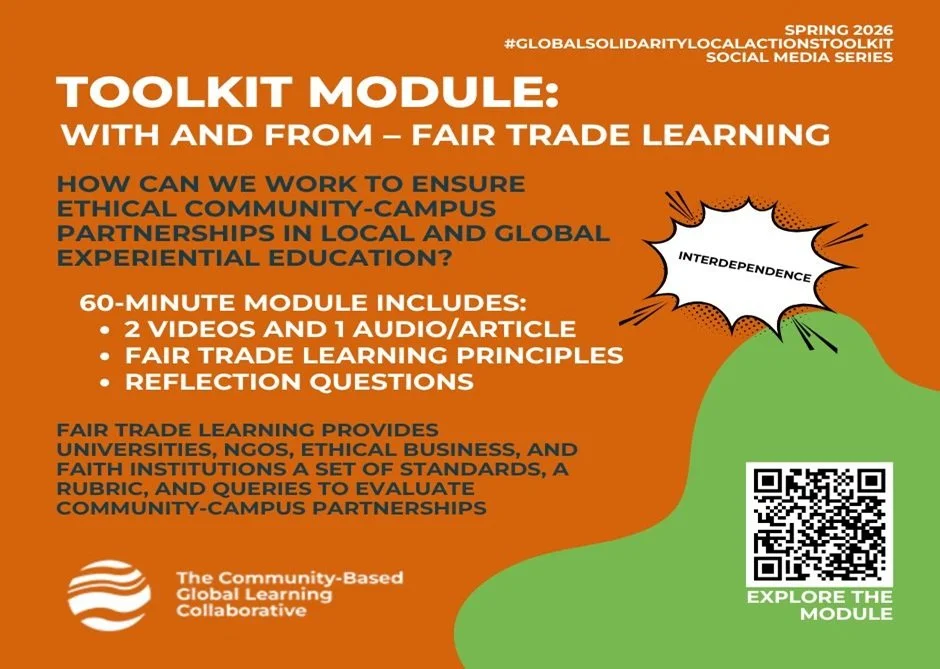
With and From – Fair Trade Learning
It is complicated and difficult to “do good” in civic and global education. Most host communities that receive volunteers and service-learning students would like to continue doing so, but under better terms.Using this module will support your participants in understanding critiques of conventional forms of off-campus volunteering/service-learning, communities' articulated desires for partnership, #FairTradeLearning (FTL) as a framework to promote ethical community-campus engagement, and the relationship between your own dispositions and the FTL approach. See also our social media campaign from one year ago by which this #GlobalSolidarityLocalActionsToolkit series is inspired!
-
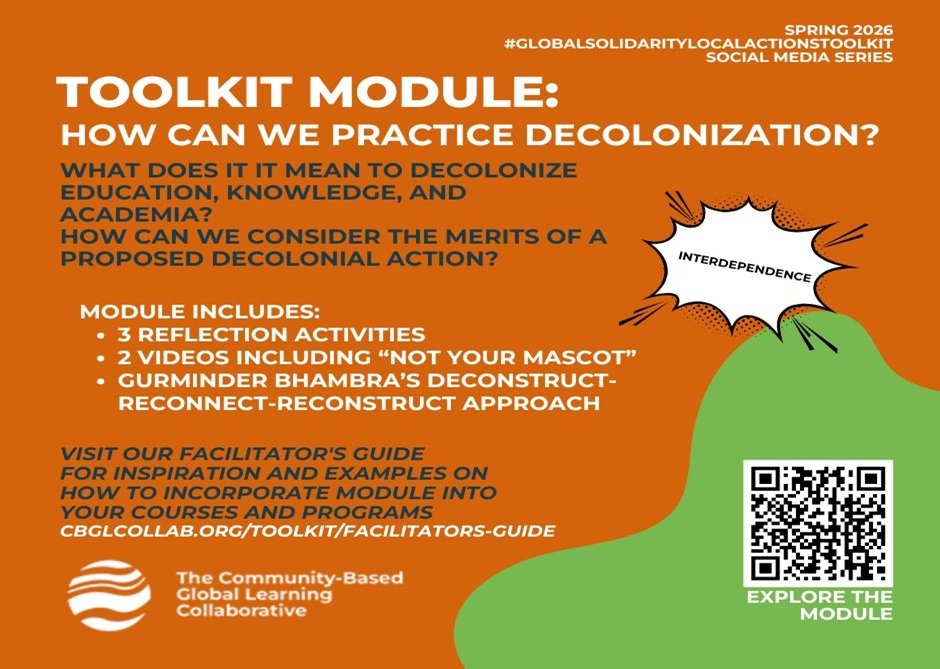
How can we Practice Decolonization?
Our monthlong Toolkit social media campaign continues!
Decolonization is a living and breathing movement, aimed at ensuring Indigenous futurity and sovereignty through dismantling the broad structures of oppression that have and continue to prevent Indigenous people from striving.
This module embodies the Toolkit’s aspiration of “global solidarity”. In one of its videos Dr. Lwazi Lushaba, lecturer at the University of Cape Town, breaks down what it means to decolonize education by using post-apartheid South Africa as an example. Our #GlobalSolidarityLocalActionsToolkit has many provocative questions for reflection (our own and for students), including:
*When did you start to consider decolonization and what brought you to this thought?
*What may have caused the delay in considering decolonization earlier in your life?
*How do you think colonialism plays a role in maintaining barriers to decolonial thinking -- yours or possibly your community’s? -
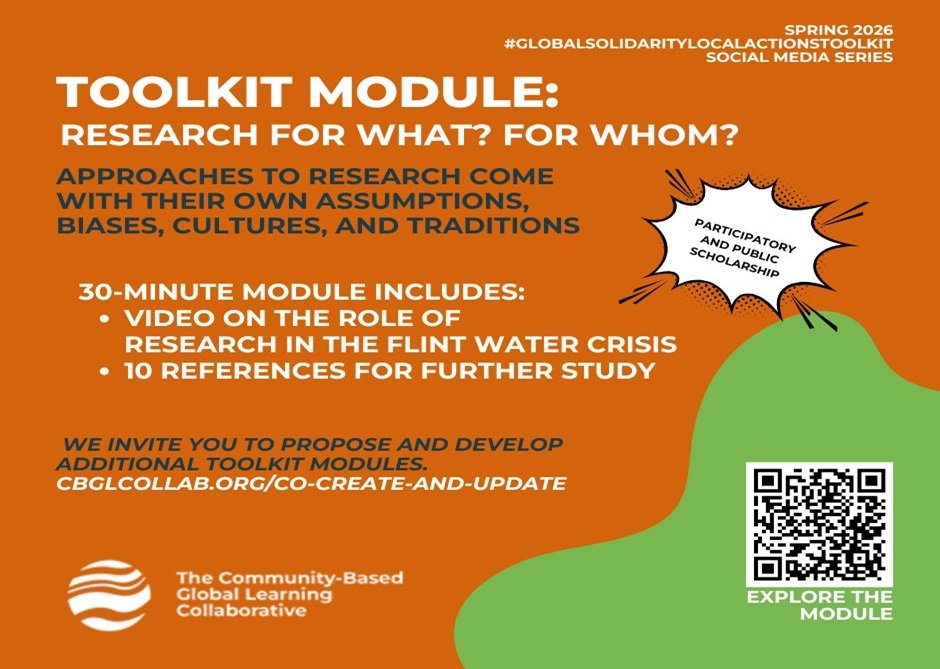
Research for What? For Whom?
In what ways “should” academic-based CBGL researchers be engaged in the public work of democracy? In this module we reference S.J. Peters, who identified four academic traditions: service intellectual; public intellectual; action researcher/public scholar/educational organizer; and antitradition traditions. Even when research emerges from someone “most affected” and results in action (policies, etc.), questions of “who” and “how” are still relevant and complicated in research with communities. This module in our #GlobalSolidarityLocalActionsToolkit is a good lead-in to two additional pages, the challenges in participatory research and several tools and frameworks that can support further reflection and analysis.
-
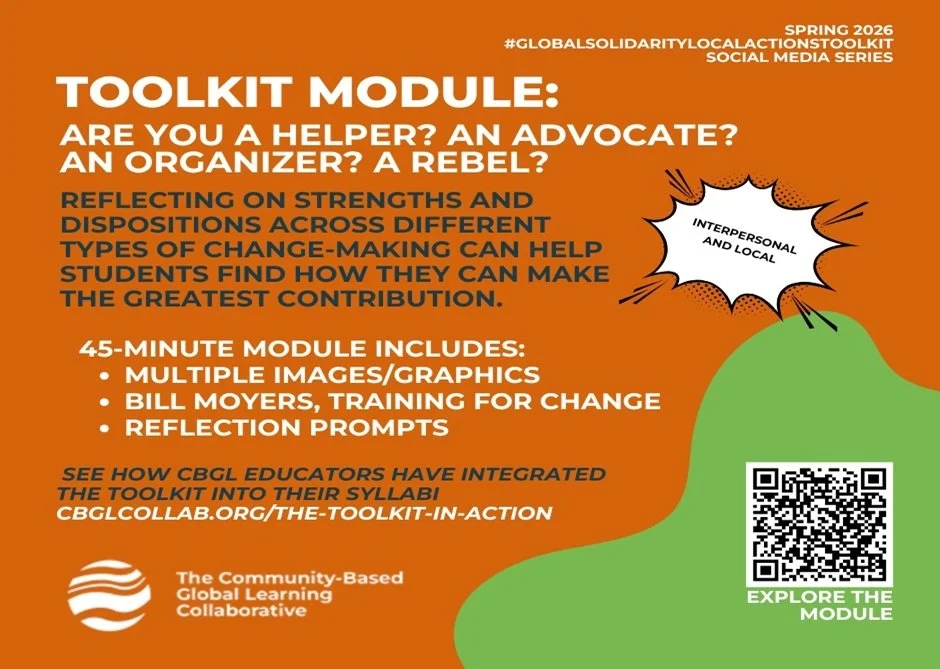
Are You a Helper? An Advocate? An Organizer? A Rebel?
As we approach the midway point of our social media series on our #globalsolidaritylocalactionstoolkit,you might see how some modules are just as useful for CBGL educators as for CBGL participants. This module can support all of us to learn to appreciate broader movements for social justice. People and organizations frequently must work together in coalitions across different change-making types in order to make meaningful and lasting systemic change.
-
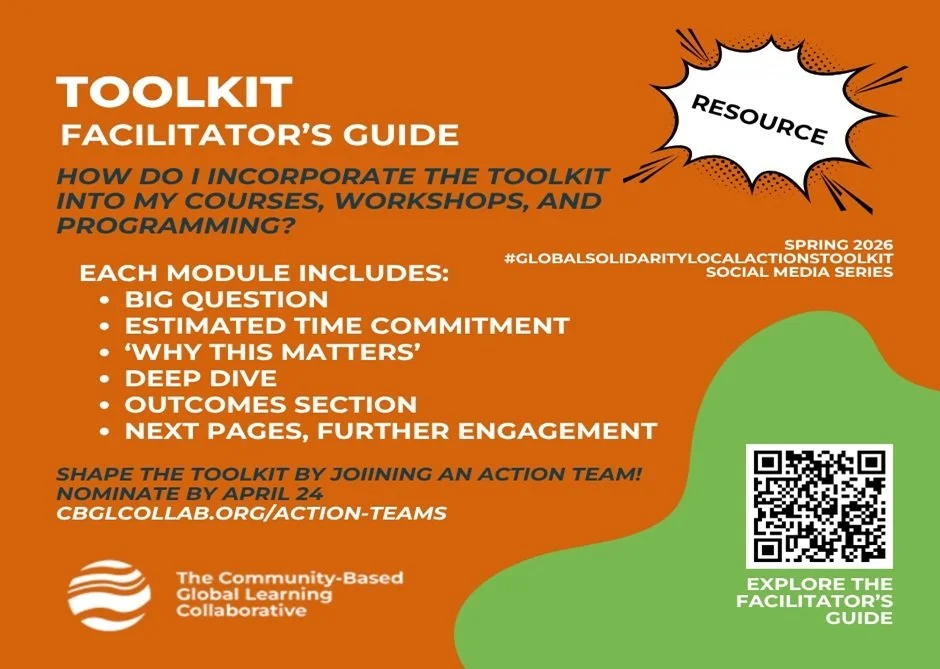
Facilitator's Guide
The Facilitator’s Guide of our #GlobalSolidarityLocalActionsToolkit supports CBGL educators to incorporate these pages into your courses, workshops, programming, etc. You do not have to be an expert to engage with the issues or modules. Position yourself as a co-learner in a group, and take time to foster trust. The Guide encourages you to self-reflect prior to facilitating the content; this allows you to familiarize yourself with it and gauge the potential flow and timing of the conversations.
-
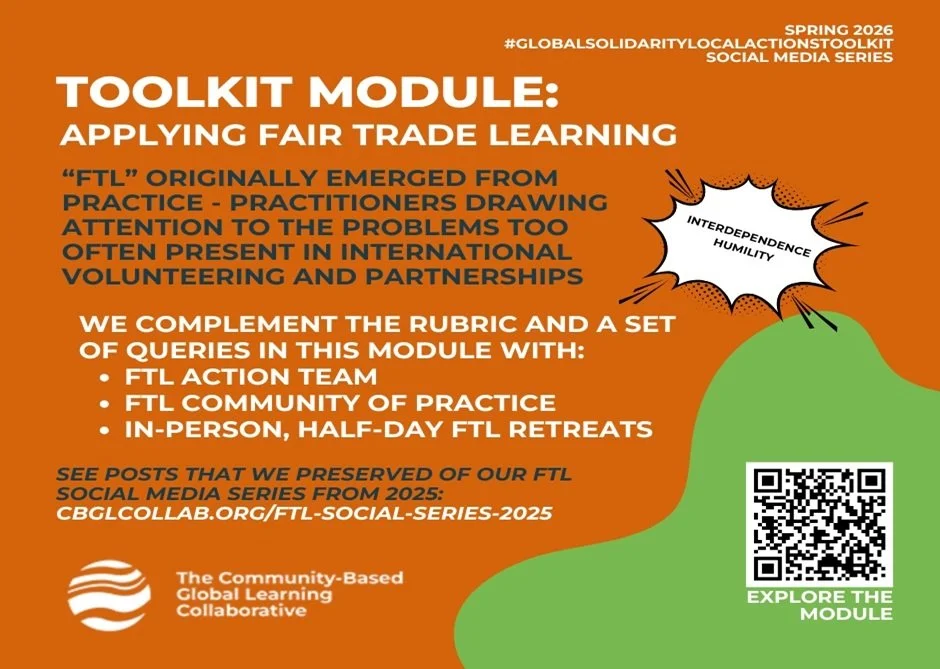
Applying Fair Trade Learning
This module more than any other highlights how the Toolkit topics relate to other aspects of the Collaborative’s work. It offers different tools that are useful to apply Fair Trade Learning (FTL) principles to partnerships, including a rubric and reflection questions. We are committed to providing the freshest FTL examples, so if you have a story of applying these principles to actual partnerships then please share with our network! Thanks to our FTL action team members, this season we are offering an FTL community of practice that is meeting over 5 months, and hope to convene another group starting in August. #FairTradeLearning #GlobalSolidarityLocalActionsToolkit
-
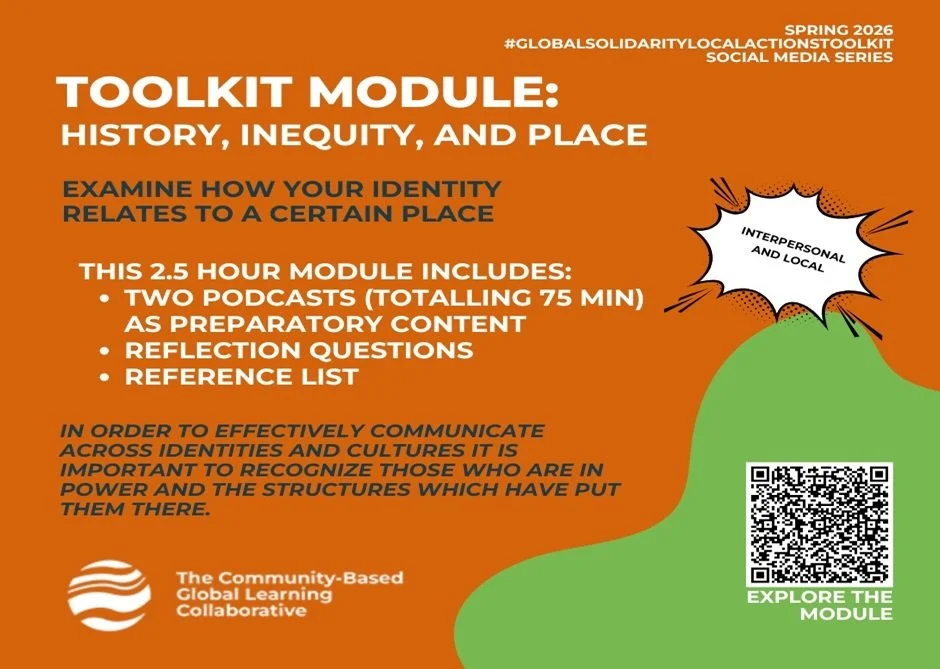
History, Inequity and Place
Post number 10 in our series focuses on history, inequity and place to support CBGL learners to reflect on who they are. How does examining historically rooted inequity help us to compare and contrast contemporary local contexts of inequality and oppression? We do not exist in individual vacuums – we must do all that we can to ensure that our interactions and transactions of identity are carried out in just, sustainable and inclusive ways. This module of our #GlobalSolidarityLocalActionsToolkit examines race, language, culture and ethnicity in France, Germany and Brazil and to interrogate power, privilege and positionality not just from a contemporary standpoint, but a historical one as well. Find the module here.
-
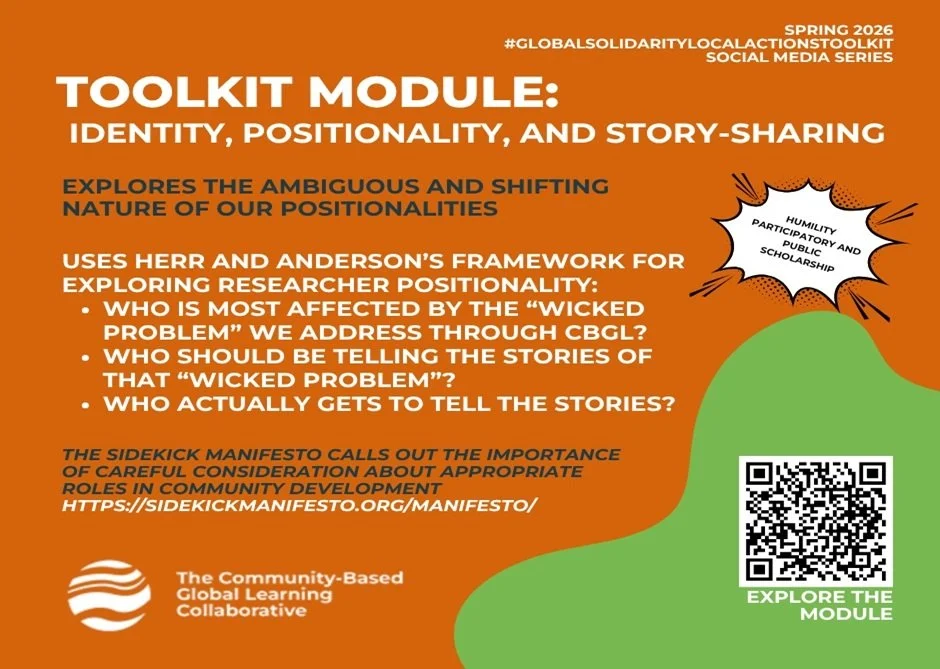
Identity, Positionality, and Story-Sharing (for researchers!)
This is an excellent module for community-based, undergraduate, graduate, and faculty researchers! The pages of our #GlobalSolidarityLocalActionsToolkit are open-access and co-created by a wide variety of CBGL practitioners. Our positionality relates to how we might share stories to advance positive social change. If I am an academic-based researcher, what is my role in a long term process of community development that is historically anchored and culturally sensitive? This module references Herr and Anderson’s continuum that highlights both the ambiguous and shifting nature of researcher positionality. Access the module here.
-
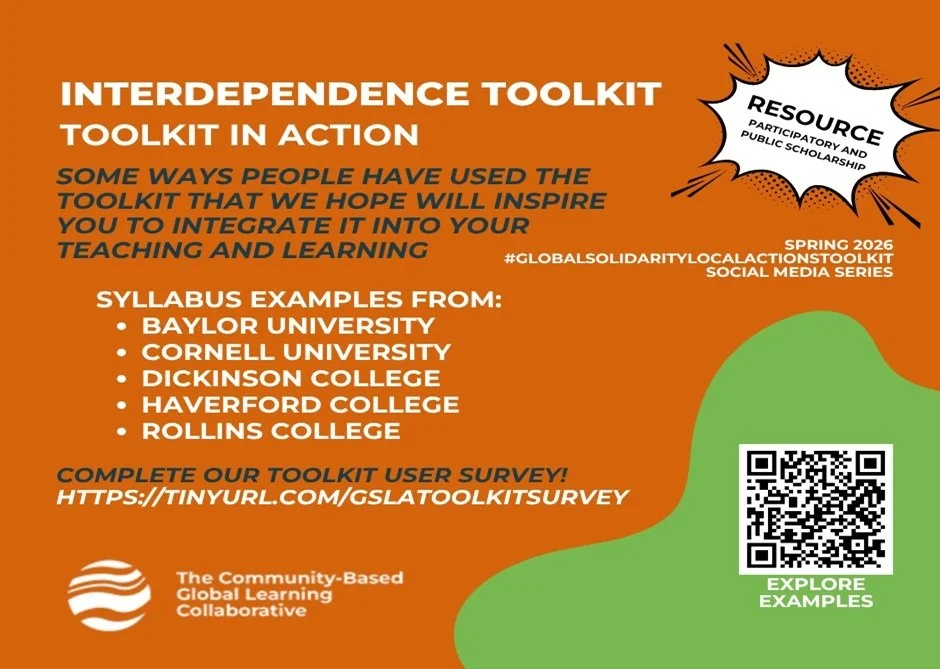
Toolkit in action
The Toolkit is a collective on-line learning and sharing initiative. It brings together educators and learners who all share a commitment to building more just, inclusive, and sustainable communities. This initiative naturally calls for open-source knowledge sharing; many who have used or are still using the Toolkit have given the Collaborative permission to share their syllabi, presentations, workshop outlines and publications. Our members model the ethos of the Toolkit, that interdependence is our lived experience, both in its creation and use. Join us in this work as either a dues-paying member or action team member – this is the final week to nominate for summer onboarding! Post number 12 in our #GlobalSolidarityLocalActionsToolkit 2026 series.
-
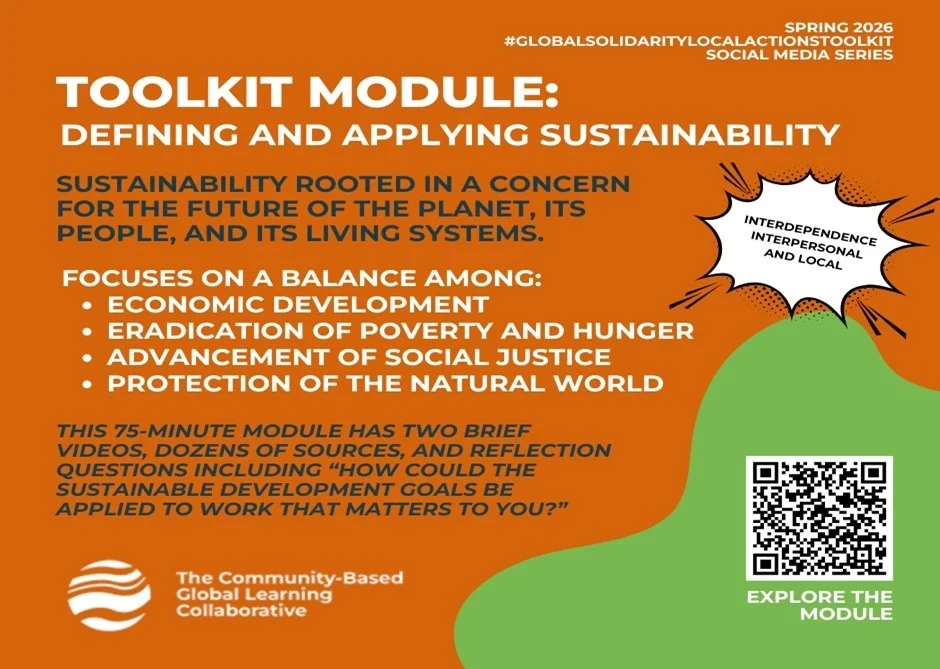
Defining and Applying Sustainability
This module defines and connects sustainability with global solidarity and local actions. It contains references to the United Nations Sustainable Development Goals and asks students to identify, target, and map local actions and outcomes back to the UNSDGs. The Collaborative believes that solutions for the planet cannot be at the expense of people or our economy, and people and the economy are core to creating the needed progress for our planet. One of the many resources on this module is Kevin Kecskes Sustainability of Our Planet and All Species as the Organizing Principle for SLCE. Together with other modules in the #GlobalSolidarityLocalActionsToolkit we ask, how do we improve the human condition equitably in this and future generations, while conserving environmental systems necessary to support healthy and vibrant societies? Post number 13 in our 2026 series.
-
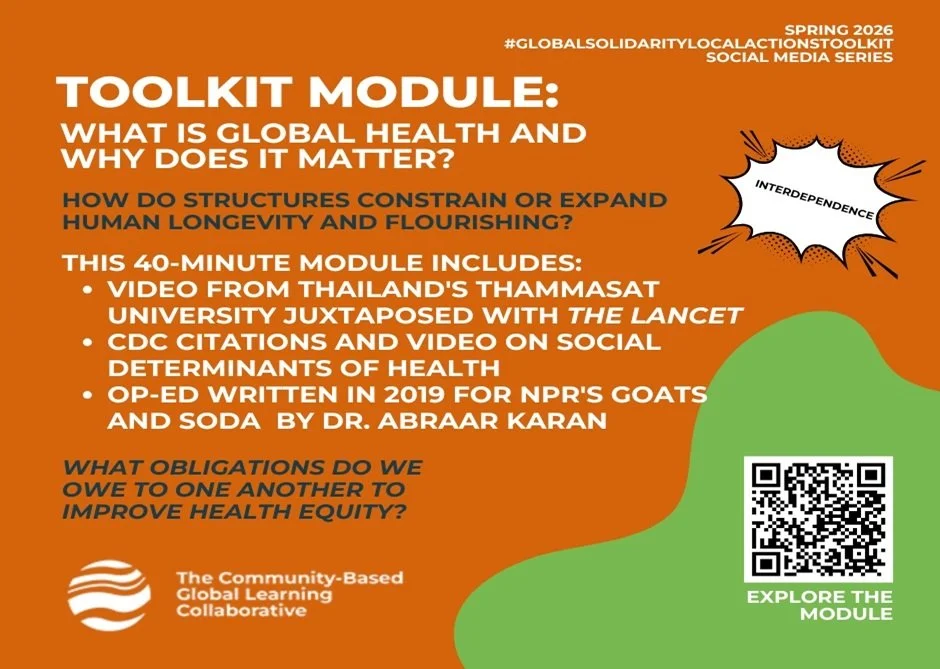
What is Global Health and Why Does it Matter?
Global health aligns with the concerns of global citizenship. In both a central concern is with the obligations we owe one another to improve health and health equity. Underlying public health factors are often referred to as social determinants of health. This module of our #GlobalSolidarityLocalActionsToolkit has a wealth of resources. The list of citations, mainly compiled during the COVID-19 pandemic – including a citation by the US Centers for Disease Control in May 2020 – provides a glimpse into how shifts upstream impact the work downstream. See the full module here.
-
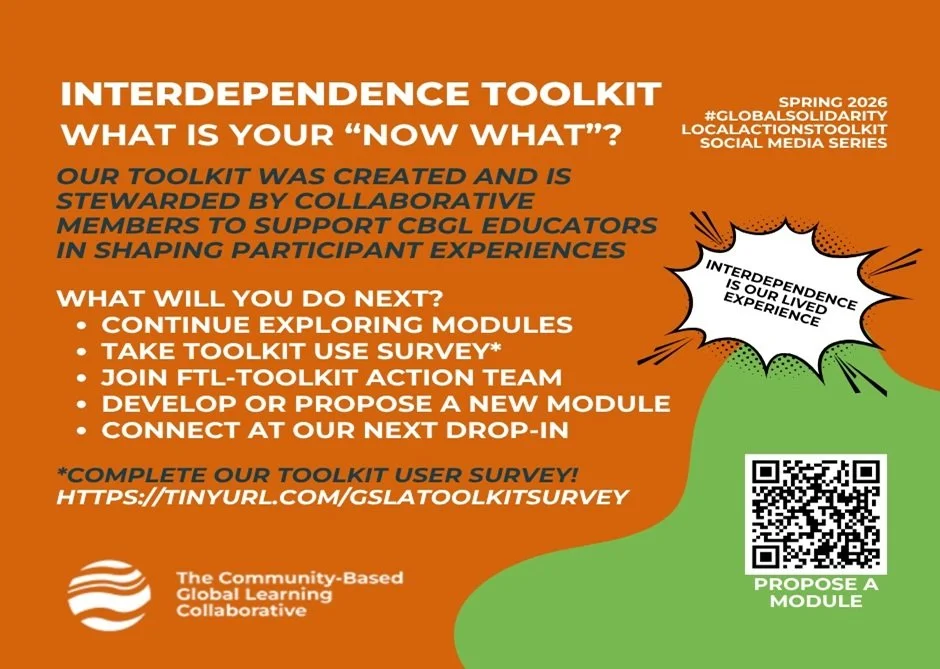
What is your "now what"?
What is your next step? In this our 15th and final post of our #GlobalSolidarityLocalActionsToolkit 2026 social media series we invite you to strengthen our free online teaching and learning resource. We hope the series has inspired you to (re)commit yourself to designing community-based global learning content before, during, and after your participants’ CBGL experiences. Over summer and fall our FTL-Toolkit action team members will continue to interview respondents to our toolkit use survey. Drop-in on us anytime to ask a question or offer a story and stay connected through our newsletter and social media!