By Maya Malik, PhD student, University of Wisconsin-Madison, Curriculum and Instruction program at the School of Education
Note from the author: For the purpose of this essay, I use the terms graphic novel and comic interchangeably because in lots of the literature, there is no real distinction. Some folks label graphic novels as an anthology of comics, comics for adults, or longer, novel-length comics, but there is no standard or agreement on the differences between each term.
How are comics their own way of knowing?
There is a debate in the comics community that got stronger when it officially entered academia. Are comics simply a form of storytelling/ format, or are they their own way of knowing that allows their audience to make meaning in specific ways?
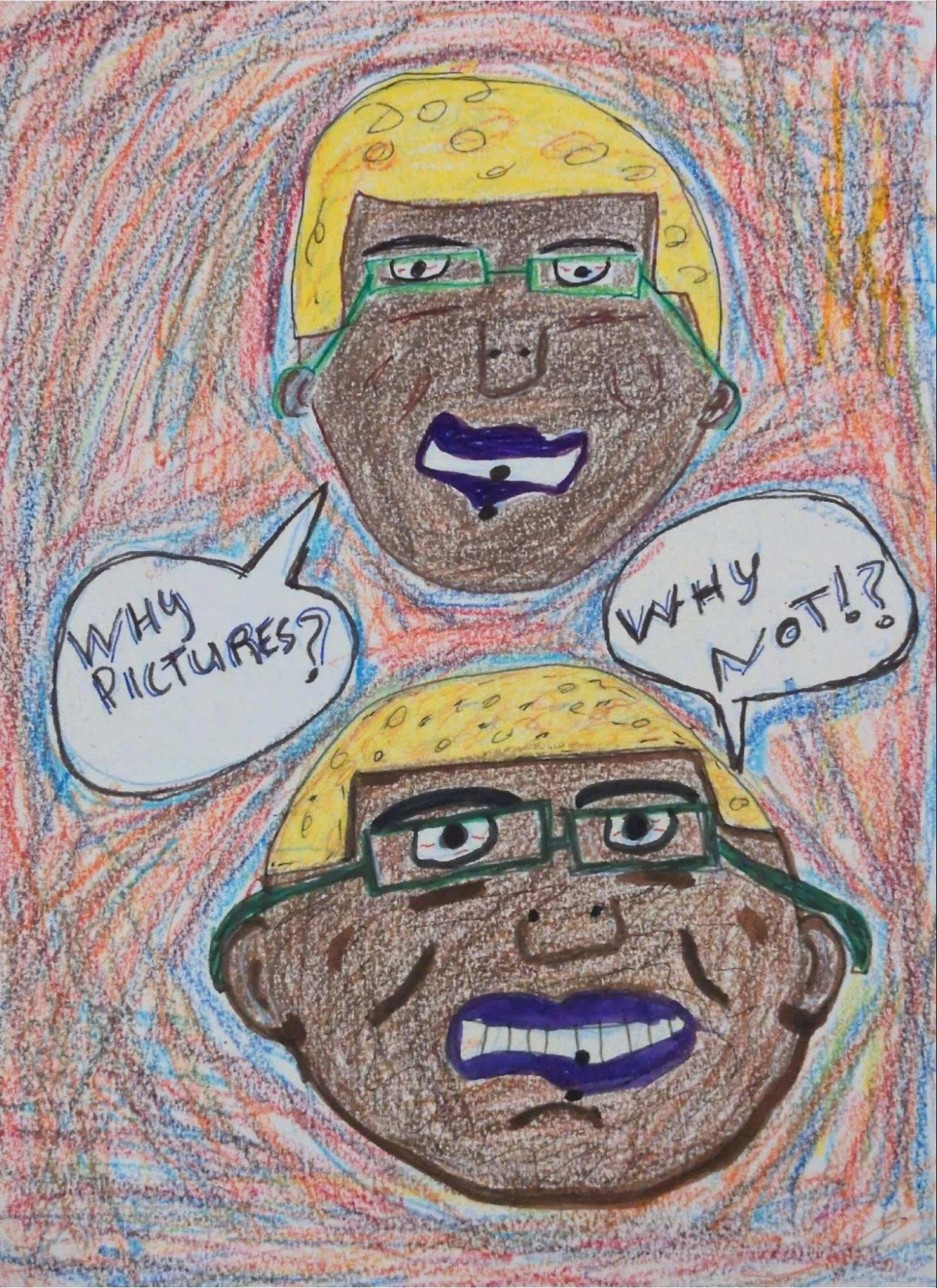
Reflectivity in Qualitative Research
Reflectivity is a large part of validating qualitative research. It allows the researcher to hold themselves accountable, document the process and how it’s changing, and provides some trustworthiness with regard to the research process. This form of validation is very different than the ones used in quantitative research. Ahmed, S. K. (2024).
In the 2024 article, focusing on surgeons, Ahmed stated that, “[r]eflexive journaling enables researchers to record their thoughts, biases, and reflections, promoting transparency and reducing subjectivity”. I agree with most of the points, except the last one that focuses on reducing subjectivity. Just like recording your biases does not completely get rid of them, writing your process down definitely allows transparency, so that the subjectivity of you doing this work can be included in the analysis and acknowledged.
In most research, there are a lot of choices that come down to a person’s past experiences and decisions that other researchers would have made differently if they were involved. We write these down to show how we got to the question, through the data collection, any pivots, what the analysis was supposed to look like compared to what it actually looked like, any conclusions we may come to, and why all of these things happened. His implications regarding reducing subjectivity suggest that he believes objectivity can be achieved. In my opinion, that influences the work. Objectivity is a myth that I, as a constructivist, cannot understand or support; I cannot support that positivist line of thinking. Reflexivity is essential to all research, not just qualitative and arts-based projects.
One of my favorite aspects of qualitative research is the need for a reflexivity journal. In this journal, the researcher writes down important facts about themselves, the research process, why they make the choices they do, and analyzes their positionality with regard to the work. I personally begin by writing down why I want to do this work and why I feel I am particularly situated where I can do this work and make sure they align. If a community comes to me with a quantitative research project around a specific type of insect, I would not take the project and would try to steer them to someone with the expertise that they need.
My interest in the research, ability to do the work, and what the community or area I’m working with all need to align. This means there are projects that seem fun or interesting that I may turn down because I realize I may not be able to tackle the project in the way the other stakeholders want. I practice discernment and try to be in spaces that are mutually beneficial for myself, the rest of the research team, the community, and the project.
Secondly, I write down my understanding of the project and the question asked to see how it relates to me. As someone who has been in research for many years, I know how difficult it is for met o get through some of the more tedious aspects of the research process without any passion or interest in the work. I need to figure out if the question has elements that I’m curious about or if they are utilizing a method I am interested in, or if they are working with a community that I can be a liaison to. After this step, sometimes I might rethink the project.
Depending on the situation, I might ask to do specific work like interviews or archives to stay involved in a way that is meaningful to me. This goes into the next big part of my process. These sections are not in any order and can be done at any time. I often think about the project in the beginning, so that if I need to make a change, I am not too entrenched in the work so that it is still possible.
Next, I write down all of my biases and possible expectations for the work. If I am on a large research team, I will have a meeting with my supervisor to set realistic expectations for the work I am expected to complete and the methods I need to use. I also like to be honest if I have a personal connection to the topic that might make it harder for me to focus on the research at hand. On the flip side, I also talk about the strengths of my positionality and how the project can benefit from my work.
The reflexive journal is only one part of the research process. I often have another document where I write down what is being done, step by step. There are also usually some peer coding meetings to talk about reliability. There are usually efforts to triangulate by talking to different stakeholders or to find different data to compare the data I just collected.
In most of the research I do, there is a Community Action Board (CAB) or a Youth Advisory Board (YAB) that we can bring the work to and get feedback on. This step is crucial and has changed the direction of research I was working on for the better. These folks are experts in their field, experts in the area, experts on the community, and often have a personal connection to what is going on. This is your biggest tool to make sure your research is on the right track. It is also the tool that is often overlooked by mixed-method students and devalued by funders. Regardless of what is said, having different stakeholders from the community or population you are working with is essential to framing any problem and moving forward with collecting the most meaningful data.
Comics as a Reflexivity Tool
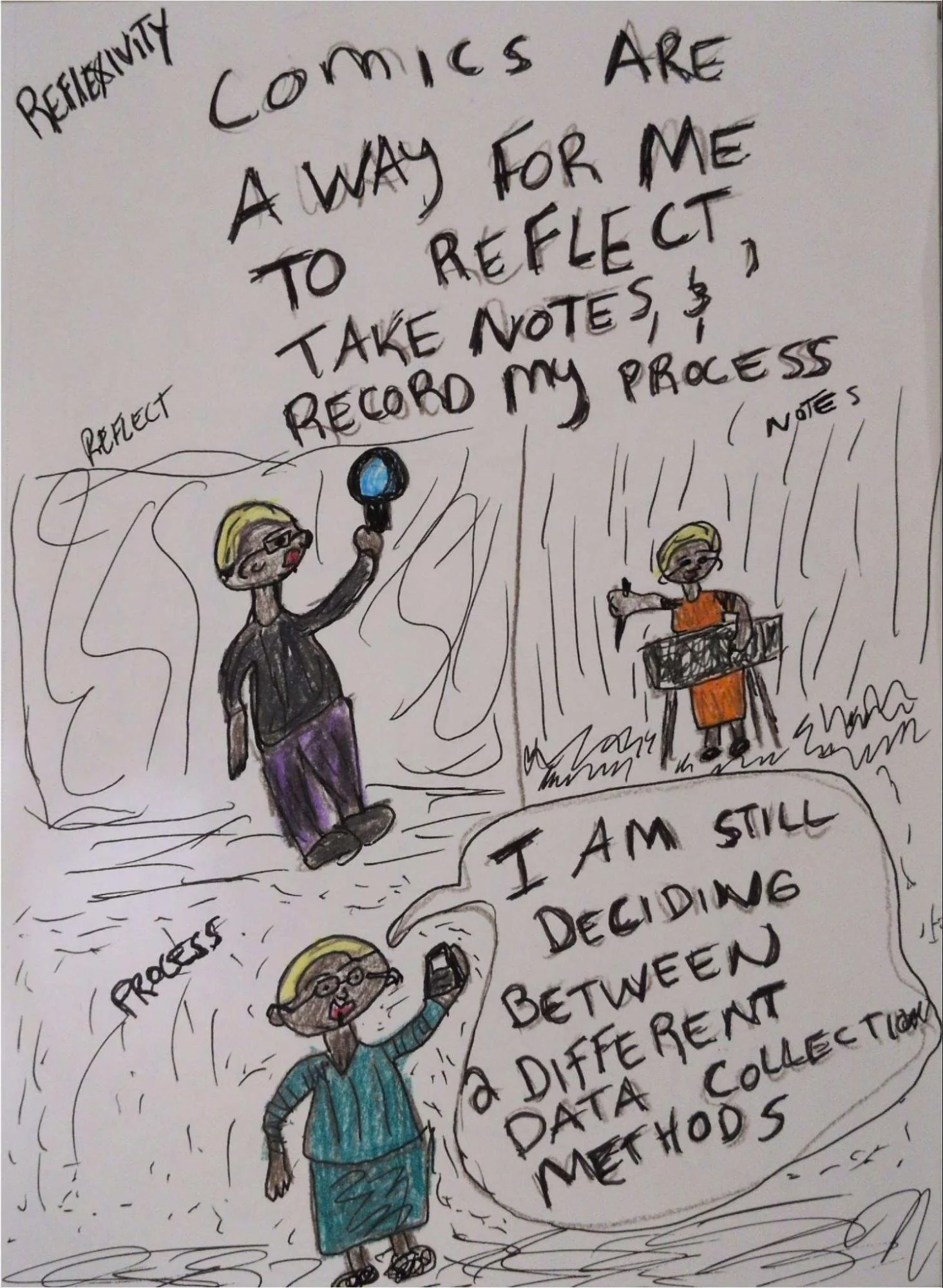
I personally have started to use comics as a reflection exercise and sometimes for reflexivity in the researcher journal. I take details about what is occurring, or memorable moments, or even moments of frustration, and I write them down with a short description. Sometimes the description helps me further process my feelings and thoughts, while other times it is just a basic description of what happened and what I plan to draw. The physical act of drawing allows me to tap into a way of knowing and understanding that doesn’t happen when I use a computer or stylus. It is a process all of its own.
My Relationship with Writing and Drawing
I do not have the greatest relationship with drawing or writing. It had been a lifelong struggle that I’ve had to overcome. I was not good at coloring inside the lines. My fine motor skills were horrible and affected every part of my life. I got points taken away on math problems because my teacher couldn’t read the numbers I wrote. I got terrible grades in handwriting class where I would end up crying because I made holes in my paper trying to erase my messy handwriting.
I was so focused on grades that I would almost hyperventilate when thinking about my art and handwriting grades. I tried so hard. Worked on it all the time, and nothing changed. My handwriting teacher noticed how often I would leave her room crying, so she started putting poems from my favorite book on the board as the warm-up. She saw my Langston Hughes, Dream Keeper and Other Poems, and I got to write his words once a week for months. I’m not sure the other students noticed or cared about the poems, but it meant the world to me.
It would take until my early 20s to get diagnosed with Attention Deficit Hyperactivity Disorder and Dysgraphia (currently known as Specific Learning Disorder using the specifier "with impairment in written expression in the DSM-5). This diagnosis was a big deal. It showed that it wasn’t a lack of effort on my part that my handwriting never improved. It also allowed me to access accommodations and support that would actually help me through school. This support basically let me stop writing altogether, except for a few final exams.
I was the kid who always brought my laptop to class, even the ones that the lecturer did not like technology around. It was part of my accommodation and made it possible for me to take notes that I could successfully read later, as well as organize the information in a way that made sense to me. Even when instructors push for handwriting things in class, my accommodation allows me to be the exception.
Comics Course
With all this in mind, I let some great people talk me into taking the Making Comics course at my university. They appealed to my goal to become an arts-based researcher and to learn as many methods as I can to co-create meaningful work with youth. They told me it wasn’t about how good you were at drawing but more about the journey and what your drawing was trying to say.
As someone with a background in social work where I’ve worked with youth from backgrounds of violence using the arts, I could get behind the idea of focusing on the message. The big obstacle was no computer. She liked everything done by hand. I was so scared because it had been so long since I moved my hand in that way. But when I met Lynda and we did our first drawing activities with our eyes closed, I knew I was in the right space.
Lynda focuses on helping her students find “their line,” like their voice in drawing. We all have a style even if we don’t see it or don’t want to see it. She talked about drawing as exploration and how kids do that all the time. She asked questions about how old we were when we stopped drawing to explore and started drawing for the output. Every day in her class slowly healed my inner child. I figured out I enjoy drawing. I really like trying new things. I sometimes enjoy not knowing what things are going to be and just going with the flow.
One of the best things Lynda taught me, and I’m still a work in progress, is her practice of having a daily diary. Throughout the course, she showed us different structures and ways to do the diary. All pictures, no words one week. Then, using colored pencil and then watercolor, then next. After that, we were to draw something you are looking at and write a vignette from its point of view about you.
We made triangles and squares. We used photos and notecards with prompts on them. We would switch and look at eachother’s work. Sometimes we would add things to other people’s work. We would draw ourselves into famous pictures. Make ourselves insects and Batman. Only use grey tones and ink.
As a result of this class, I made a 32-page zine. I drew every piece that was in there, including the front and back covers. My hand does get tired, so I’m learning to take things slow and rest. My notebook isn’t going anywhere.
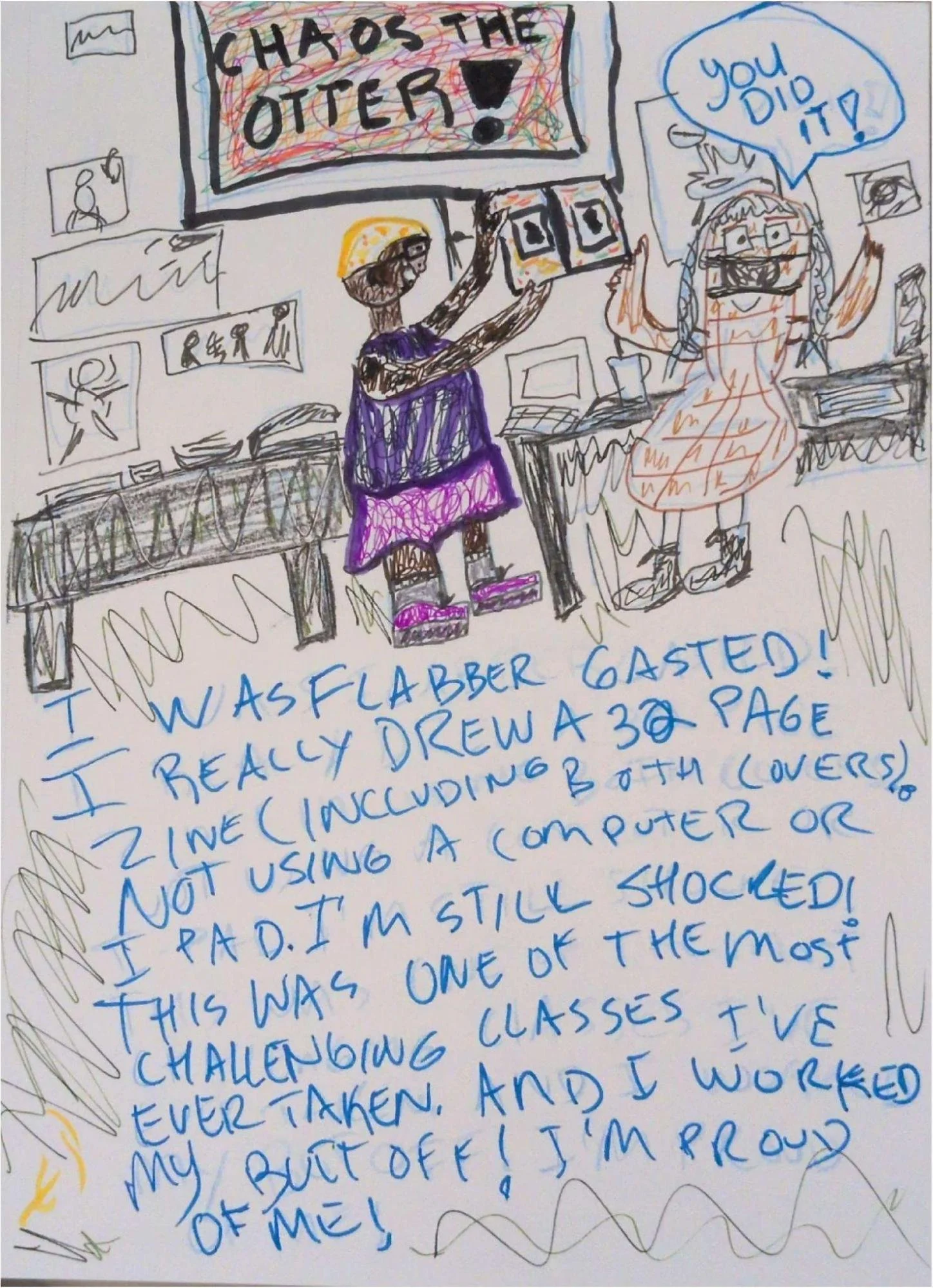
Even though the class is over, I’ve been keeping up with the diary as much as I can. Not focusing on how “good” the drawings are. An art therapist doesn’t tell someone explaining their trauma that the picture they drew isn’t good. A social work researcher doesn’t tell former child soldiers that their perspective is off and could be better when they are drawing the terrible events they’ve been through.
Drawing can be a release, but comics are their own beast. I like the way a comic combines different elements to get the point across. Sometimes a picture isn’t enough, sometimes words aren’t enough, sometimes shapes and spacing aren’t enough, but when you put them all together you get something so spectacular. It's not about any individual element, but how they work together to create meaning. They help me understand things better, and hopefully they help others too.
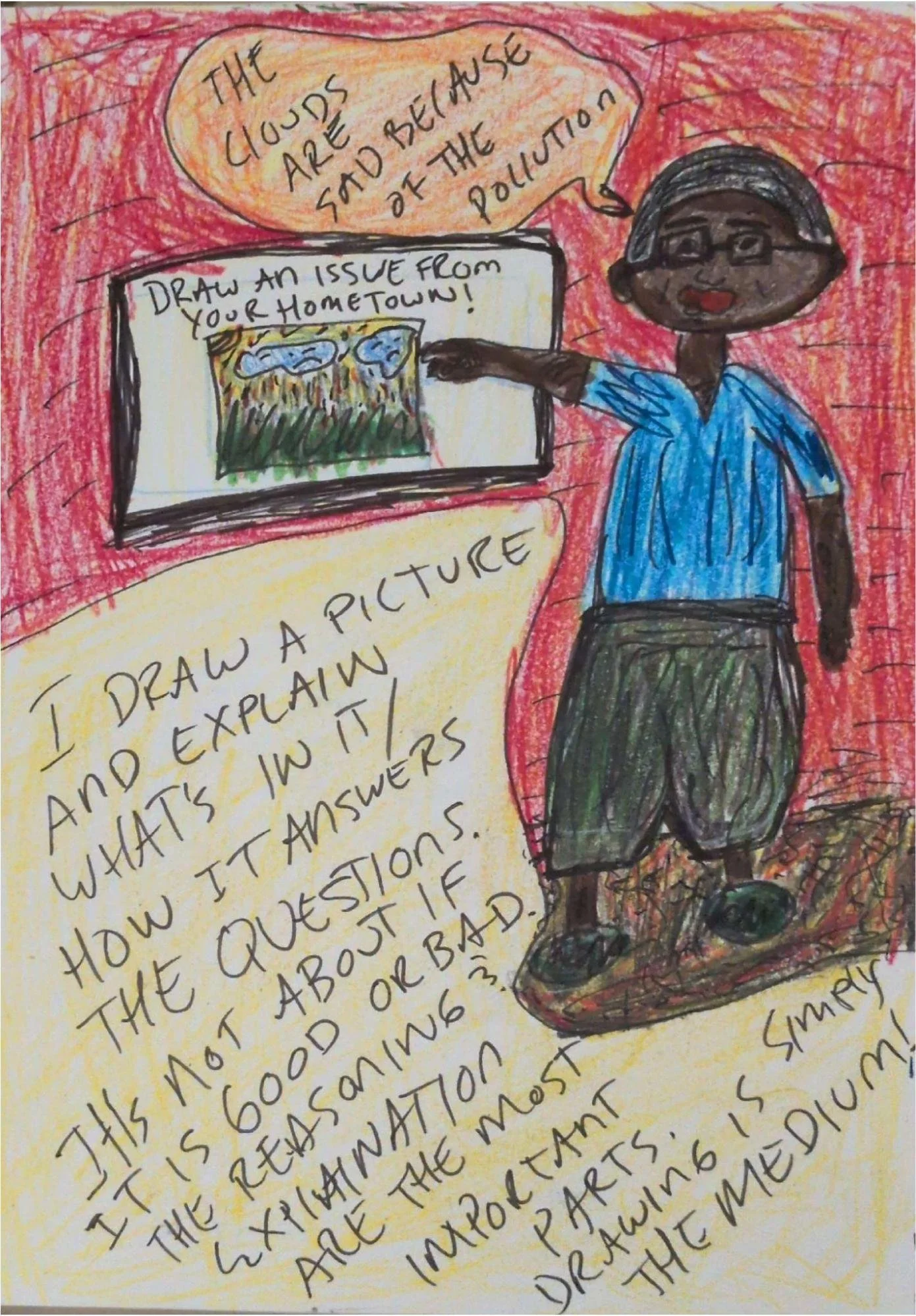
Comics in Research
Comics have been used in a variety of research. Some focused on course design, some center lived experiences with migration, some to assess learning, others to create and evaluate interventions.
Here are some of the ways comics are currently being used outside of literary studies and papers to match.
Exploration of Self and …
Migration
Autographics as autoethnography: comic book adventures of a migrant academic
Health
Exploring Using Personalised Comics for Healthcare Communication for Patients Living With Hemodialysis
To Strengthen Memory Recall for those in Late Adulthood to Combat Early-onset Alzheimer's and Dementia Dignosises
Reflections of being a Therapist in Training
Comics for re-storying self: Revisiting autoethnographic research from student placement
Comic process of Autoethnography
“Superhero City”: A Comic Book Reader’sAutoethnography
Picturing Girlhood
Chapter 1. ‘It’s the girl!’: Comics, Professional Identity, Affection, Nostalgia and Embarrassment
Qualitative Research
All aspects of the Qualitative Research Process
Exploration and specificity: a critical analysis of uses of comics as a method across qualitative research processes
Makes the Case for Comics as Research (in Clinical Work)
Comics are Research: Graphic Narratives as a New Way of Seeing Clinical Practice
Academic Writing/ Higher Education
Critical Reflection Tool in Professional Education (Early Childhood Educators)
Using comics as a tool to facilitate critical reflective practice in professional education
Comic Essay
Intro to the Comic Essay
Assessment for Comic Essay
An arts-based inquiry-inspired rubric for assessing college students’ comic essays
Decolonizing Medical Education
Creating comics, songs and poems to make sense of decolonising the curriculum: a collaborative autoethnography patchwork
Adult Literacy/EFL university students
Online English Comics as Reading Materials for English Language Education Department Students
Assessing Adult Skilled Readers
Is Comprehension in Comics More Effective Than in Traditional Texts in Skilled Adult Readers? An Eye Movement-Based Study
K-12 Education
Design-Based Research Focused on Literacy for Youth
Exploring the creative methods of comic language in augmented reality children’s book
Youth Literacy through Creating Comics
Caticorns and Derp Warz: Exploring children’s literacy worlds through the production of comics
Work Cited
Ahmed, S. K. (2024). The foundational pillars of qualitative research trustworthiness. Journal of Medicine, Surgery, and Public Health, 2, Article 100051. https://doi.org/10.1016/j.glmedi.2024.100051
